
When the Bridge Ends: Why Palliative Care Matters in Advanced Liver Disease
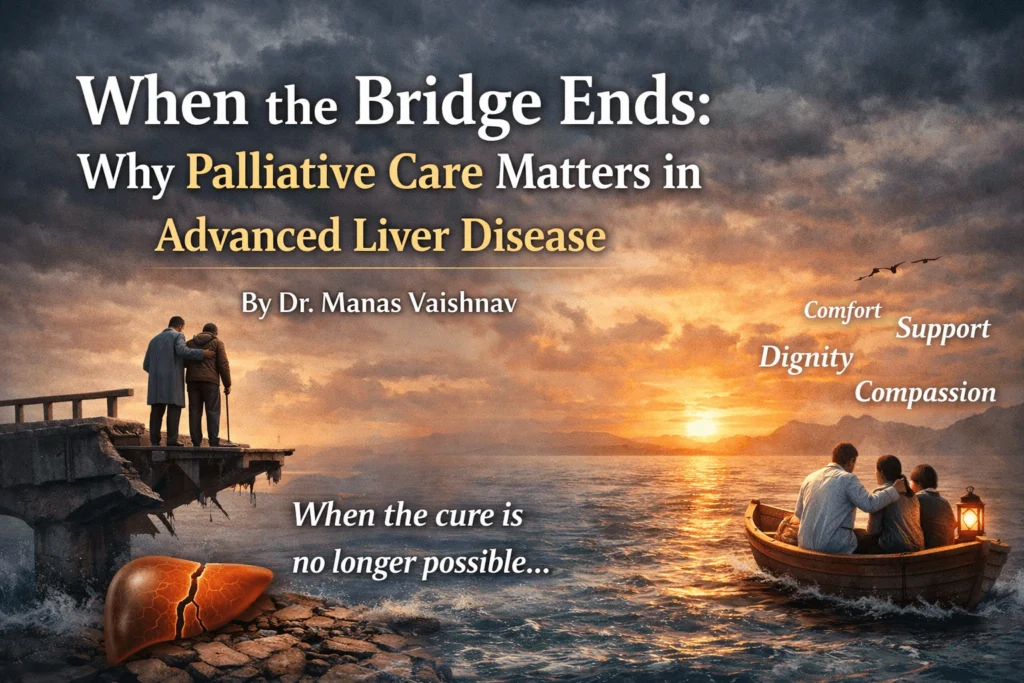
Introduction: The Bridges We Build
In hepatology, we often talk about “bridges.”
- We bridge patients to liver transplantation.
- We bridge them through complications such as variceal bleeding.
- We support them through the storm of Acute-on-Chronic Liver Failure (ACLF).
These bridges represent the interventions, treatments, and critical decisions that help patients survive the most difficult phases of liver disease.
But an important question remains:
What happens when the bridge ends… and there is no shore in sight?
The Misconception in Advanced Liver Disease Care
There is a dangerous misconception in medicine—that when curative treatment options reach their limits, the physician’s role is essentially finished.
We often hear statements like:
- “There is nothing more we can do.”
- “The disease has progressed too far.”
- “Treatment options are exhausted.”
These words are often interpreted as the end of care.
But in reality, this is where care must truly begin.
The Shift from Cure to Care
Patients with advanced liver disease—especially those with ACLF or end-stage liver failure—face profound physical and emotional challenges.
When recovery or transplantation is no longer possible, the goal of medicine must evolve.
This is where palliative care becomes essential.
Palliative care focuses on:
- Relief from pain and distressing symptoms
- Emotional and psychological support
- Honest, compassionate communication
- Preserving dignity and quality of life
This is not a failure of medicine.
It is medicine at its most humane—rooted in compassion, responsibility, and humility.
Even when medicine reaches its limits, our duty to care does not.
Why Palliative Care Should Start Earlier
Traditionally, palliative care has been introduced only as a last resort.
This mindset needs to change—especially in hepatology.
Patients with chronic liver disease often endure:
- Repeated hospitalizations
- Severe and unpredictable complications
- Uncertainty about prognosis
- Emotional distress for both patients and families
Early integration of palliative care can:
- Improve patient comfort
- Support informed decision-making
- Reduce anxiety and uncertainty
- Provide holistic, patient-centered care
Palliative care should not be a fallback.
It should be an integral part of the treatment journey from the beginning.
Compassion Beyond Cure
Medicine is not only about curing disease.
It is also about:
- Standing beside patients
- Supporting families
- Preserving dignity
- Providing comfort in the hardest moments
For patients with advanced liver disease, this presence can make an enormous difference.
Even when the bridge ends,
our responsibility to care continues.
About the Author
Dr. Manas Vaishnav is a hepatologist specializing in liver diseases, liver failure, and transplant hepatology. His work focuses on advancing patient-centered care and improving outcomes for individuals living with complex liver conditions.