
The “Waitlist Lottery” vs. the MELD Score: Are We Fair Yet?
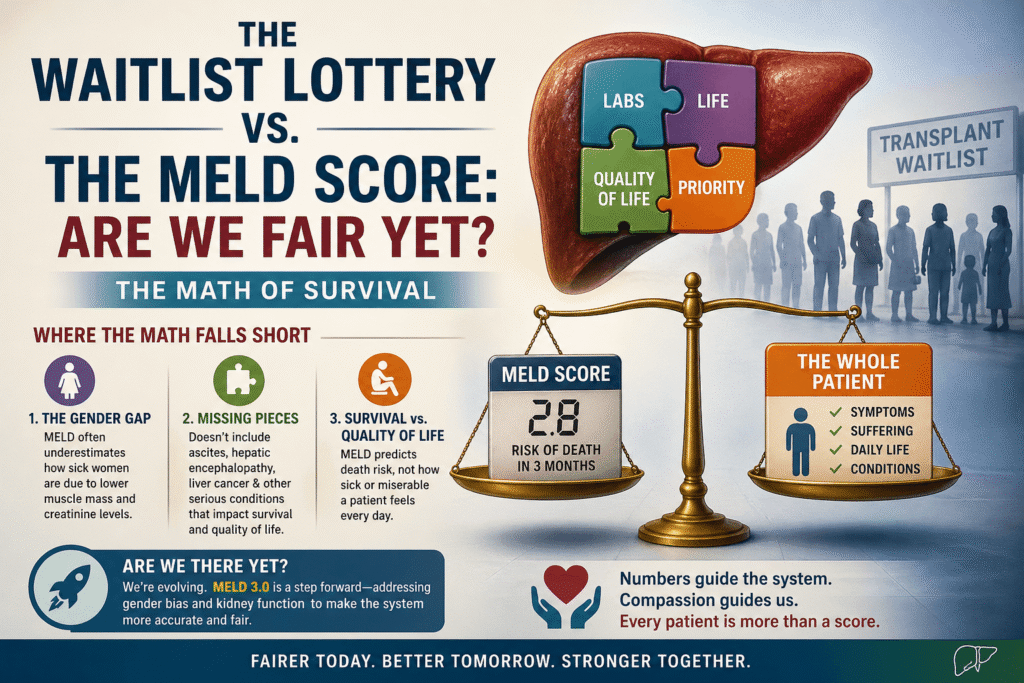
If you or someone close to you is dealing with advanced liver disease, you’ve probably come across the term MELD score. It often feels like a mysterious number that controls everything—from transplant eligibility to survival chances.
But what exactly is this score? Why does it matter so much? And most importantly… is it fair?
Let’s break down the “Math of Survival” in simple terms.
📉 What is the MELD Score?
MELD stands for Model for End-Stage Liver Disease. Think of it as a medical “sickness thermometer” that ranges from 6 (less sick) to 40 (critically ill).
Doctors calculate this score using a few key blood test values:
- Bilirubin (how well your liver clears waste)
- Creatinine (kidney function)
- INR (blood clotting ability)
👉 The goal is simple but serious:
Estimate the risk of dying within the next 3 months without a liver transplant.
How it works:
- Higher MELD score = Higher risk of death
- Higher risk = Higher priority for transplant
This system replaced the older “wait your turn” approach.
Earlier, patients got transplants based on time spent waiting. Now, it’s based on how urgently you need it.
A big step forward—but not a perfect one.
⚠️ Where the Math Falls Short
While MELD is currently the best system we have, it doesn’t always capture the full picture of illness.
Here’s where things get complicated:
⚖️ 1. The Gender Gap
One component of MELD—creatinine—is linked to muscle mass.
- Women naturally have lower muscle mass
- This leads to lower creatinine levels
- Which results in lower MELD scores
👉 Even when equally sick, women may appear “less sick” on paper
➡️ This can lead to longer wait times and delayed transplants
🧩 2. Missing Pieces of the Puzzle
MELD focuses on just 3–4 lab values, but liver disease is much more complex.
It does not directly include:
- Severe ascites (fluid in abdomen)
- Refractory ascites (not responding to treatment)
- Hepatic encephalopathy (confusion, altered consciousness)
- Certain stages of liver cancer
👉 These conditions can make life extremely difficult—or dangerous—
but may not significantly change the MELD score.
Because of this, doctors often have to request “exception points” to reflect the real severity of illness.
💔 3. Survival vs. Quality of Life
MELD answers one question:
“Will this patient survive the next 3 months?”
But it doesn’t ask:
“How is this patient living right now?”
You might have:
- Severe fatigue
- Frequent hospitalizations
- Poor daily functioning
…and still have a “low” MELD score.
👉 The system prioritizes risk of death, not suffering or disability.
🚀 Are We Getting Better?
Yes—but we’re not there yet.
The transplant system continues to evolve. A major step forward is the introduction of MELD 3.0, which aims to:
- Reduce gender bias
- Better account for kidney function
- Improve fairness in organ allocation
It’s a sign that the medical community is actively working to make the system more balanced and accurate.
🧠 The Bottom Line
The MELD score has transformed liver transplantation by shifting focus to medical urgency, saving countless lives.
But like any formula, it has limitations:
- It doesn’t capture the full experience of illness
- It may disadvantage certain groups
- It focuses on survival, not quality of life
👉 So, is it fair?
It’s the best system we have today—but it’s still a work in progress.
❤️ A Message for Patients & Families
If you’re navigating liver disease:
- Don’t rely only on the MELD number
- Stay in close communication with your doctor
- Ask about exception points if symptoms are severe
- Understand that your clinical condition matters beyond the score
Because in the end, medicine isn’t just about numbers—
it’s about people.