Liver Disease and INR: Why One Blood Test Doesn’t Tell the Full Story
Many patients with liver disease become worried when they see a blood test called INR in their reports.
Often the number is higher than normal, and patients immediately fear that they may start bleeding easily.
But here is something important that many people don’t know:
A high INR in liver disease does not automatically mean you will bleed.
Let’s understand why.
What Is INR?
INR is a blood test that measures how long it takes for blood to clot.
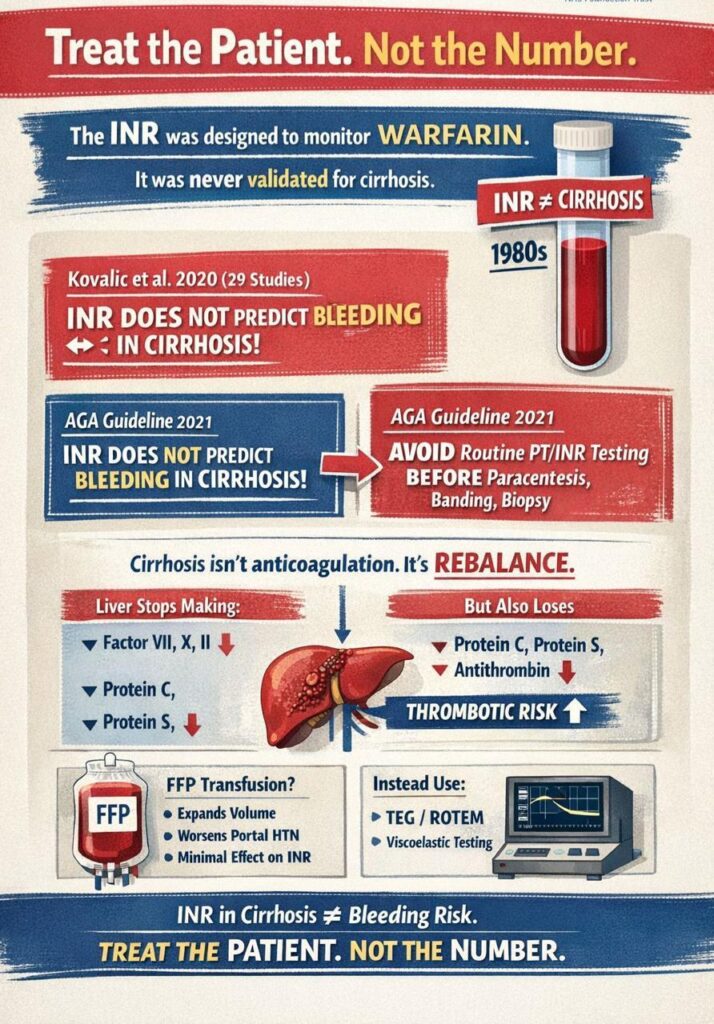
Doctors originally created this test to monitor people who take a blood-thinning medicine called warfarin.
For those patients, INR is very useful.
However, in people with liver cirrhosis, INR does not always give the full picture.
Why INR Is Different in Liver Disease
The liver plays a major role in controlling blood clotting. It produces many proteins that help blood clot.
When someone develops cirrhosis, the liver’s ability to make these proteins decreases. This can make the INR appear higher.
But there is another side to the story.
The liver also produces proteins that prevent clotting, and those proteins also decrease in cirrhosis.
So instead of becoming “too thin,” the blood actually reaches a new balance.
Doctors call this a rebalanced clotting system.
Does a High INR Mean Bleeding Risk?
Research over the past several years has shown that:
INR does not reliably predict bleeding in patients with cirrhosis.
That means a person with a high INR may not necessarily have a higher risk of bleeding.
Because of this, modern medical guidelines now recommend that INR should not be the only factor used when deciding treatment.
What About Procedures?
Many patients worry when they need procedures such as:
Removing fluid from the abdomen (paracentesis)
Endoscopy for varices
Liver biopsy
In the past, doctors often tried to correct INR before these procedures.
But newer research has shown that routine correction of INR is usually not needed for many of these procedures.
Why Doctors Focus on the Whole Patient
When managing liver disease, doctors look at many factors, including:
Symptoms
Platelet count
Overall liver function
Clinical condition of the patient
This helps them understand the real bleeding risk, rather than relying on a single lab number.
The Most Important Message
If you have liver disease and your INR is high, do not panic.
Your doctor will evaluate your overall health and clinical condition, not just the number on a lab report.
The goal of modern liver care is simple: